


You wouldn’t watch the Super Bowl on a black-and-white TV. You’d miss the flags, the jersey numbers, half the game. Yet plenty of underground sewer pipes still get judged from footage that’s nearly as murky, and the details that matter are small ones: a hairline crack, a few root hairs at a joint, a slight offset that hasn’t turned into a leak yet. That’s the case for CCTV sewer inspection with a modern inspection camera. It’s also why IBAK systems get so much attention from crews who look after sewer lines.
Armor Equipment has helped municipalities, contractors, and utilities keep sewer and water systems running for over 50 years, and it sells and supports RapidView IBAK sewer cameras. The idea behind all of it is simple. A sewer pipe rarely fails without warning. The warning just happens to be underground.
Why Sewer Inspection Starts Below the Surface
Sewer infrastructure ages out of sight. A damaged pipe looks the same from the street, and a sewer main can be partly blocked by tree roots for months before a backup pushes sewage into someone’s basement. Camera inspection changes the timing. Instead of reacting to a collapse or an overflow, crews assess the condition of a pipe while the damage is still minor and the fix is still reasonable.
That’s what early detection really means. Every inspection is a snapshot you can compare against the next one, so slow change becomes visible. Find the small stuff now, schedule cleaning or fixes on your own terms, and skip the emergency excavation. Municipal sewer departments and utility crews use it for infrastructure management across the whole sewer system. Plumbing professionals use it to diagnose a stubborn drain or a drainage problem nobody can explain before anyone opens a yard. Homeowners mostly notice it as the backup that never happened. Whether it’s a city’s sewer network or a single service line, the logic is the same.
How a CCTV Sewer Camera Actually Works
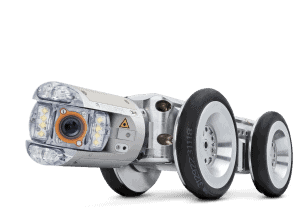
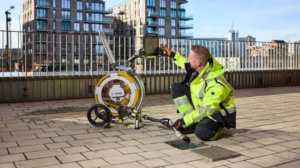
A CCTV inspection is non-invasive, so nothing gets dug up. A waterproof camera head travels through the pipe on a motorized tractor or, for smaller lines, a push rod, the setup a plumber would reach for. A cable reel feeds it, a controller lets the operator steer, adjust lighting, and zoom in real time, and software handles video recording and defect identification. Every observation is logged against distance, so a fault noticed at 212 feet can be found again at 212 feet. Many systems also include a sonde, a small transmitter that lets a locator pinpoint the camera from above ground, which is how a crew can mark the exact spot for a dig should that be necessary. The footage also doubles as a permanent record of the sewer pipe on the day of the inspection.
There are two broad inspection methods. With pan-and-tilt pipe inspection cameras, an operator steers the view live. Scanning systems, like IBAK’s PANORAMO, capture the whole pipe as the unit travels and let you review it afterward. Armor’s IBAK lineup covers both.
Sewer Pipe Defects a Camera Inspection Can Catch Early
Inspectors sort what they find into two groups. Structural problems involve the pipe itself. Operational and maintenance problems involve how well it carries flow. Camera inspection catches both kinds of sewer problems, and the early versions of each are the ones worth finding.
- Cracks. A crack that isn’t visibly open is a minor finding. Once it opens, it’s coded as a fracture and carries a higher severity grade. Catching the crack stage is the point.
- Root intrusion. Roots find joints and openings and grow toward the water. At first, it’s a few fine roots at a joint. Left alone, it becomes a blockage and a repeat service call. Clear, high-resolution sewer inspection footage separates root hairs from staining.
- Offset and separated joints. Pipe sections that have shifted leave a step or a gap. Those separations in the pipe let soil in and water out, and they often show on camera long before the ground above settles.
- Infiltration. Groundwater weeping through joints or cracks shows up as dripping or running water. It also overloads the sewer system downstream, which is why utilities track it closely.
- Corrosion. In concrete and some older pipes, the pipe wall roughens and loses material, eventually exposing aggregate. Early pipe corrosion is a change in surface texture. Late corrosion is a missing pipe wall.
- Deformation. Flexible pipe such as PVC can squash out of round under load. The change is slow, which is why measuring beats eyeballing.
- Sags, deposits and blockage. Low spots hold water and solids, and grease builds up. Not every finding is structural. Some just tell you when to clean.
- Lateral problems. Damaged connections, tree root infiltration, intruding sealing material, and broken laterals are common trouble spots on any sewer lateral.
Where IBAK Inspection Cameras Earn Their Keep
The ORION 3 is a pan-and-tilt workhorse for sewer pipe inspection. It’s an HD/SD adaptive camera that outputs full 1920 by 1080 HD, 1280 by 720, or standard definition, depending on what the system supports. It pans plus or minus 120 degrees and includes a built-in laser for deformation and diameter measurements when paired with IBAK IKAS software, an integrated sonde transmitter, and optional 3D mapping. The laser matters more than it sounds. “It looks a bit oval” isn’t a finding. A measured deformation is. It also works on push-rod systems and IBAK tractors, which keeps sewer inspection work flexible when pipe sizes vary from job to job.
On the scanning side, the PANORAMO 4K uses twin 185-degree digital cameras that photograph the pipe as they move, then assemble a 3D interior view. The maker says it produces a 360-degree view, an unfolded view and a geometric view, at up to 69 feet per minute, and describes 4K as four times the resolution of full HD. Since the field inspection becomes data collection and the condition assessment happens afterward, nobody’s racing to spot every issue live, and a small flaw is less likely to slip past. The smaller PANORAMO 150 is said to handle over 90 percent of the pipelines found in sanitary sewer systems, and the PANORAMO SI 4K applies the same approach to manholes.
Armor’s Sewer & Water lineup includes the RapidView camera truck, the ORION 3 HD/SD camera, and both the PANORAMO 4K and PANORAMO 150 4K cameras.
Cleaning, Coding, and the Limits of Any Camera Inspection
Clean first. Grease, sediment, and debris hide the sewer pipe wall, so jetting comes before a sewer inspection if you want a real look. Armor carries sewer combination trucks, jetters, and nozzles for that step, which helps when the same crew does both jobs.
Know the limits, too. A camera sees what’s above the waterline. Standing water in a sag of any sewer line hides whatever’s under it, and no camera sees voids in the soil outside the pipe. Sonar profiling covers the submerged part of the pipe, and the IBAK range includes sonar tools for that.
Then there’s consistency. Findings only become comparable data when they’re coded the same way every time. In North America, that usually means PACP, and IBAK’s IKAS software supports PACP-style inspection and reporting. Pipe material shapes what you’ll find, too. Clay tends to split at joints and take roots, concrete can corrode, and flexible plastic can deform, so knowing the types of sewer pipes in your network tells you what to watch for. A professional sewer inspection also documents all of it in a form an engineer can use.
From Inspection Report to Repair Decision
A useful report from a sewer inspection says what’s wrong, where it is and how serious it is. PACP grades each observation from 1 for minor to 5 for most significant, and it keeps structural findings separate from operations and maintenance ones. That split routes the work. High structural grades typically call for an engineering assessment, while roots and deposits point to cleaning and root control. Extent counts as much as severity, too. One hole and five holes might share a grade, but they don’t describe the same pipe.
Once the picture is clear, the next step follows from it: monitoring for minor findings, a localized fix for an isolated problem, lining where a pipe has repeated fractures but holds its shape, and replacement where it’s collapsed or badly deformed. Re-inspecting the same sewer lines on a regular cycle shows how fast they’re changing. A camera-based sewer inspection program like that supports preventative maintenance and asset management, and it gives a much better read on service life than a one-time look.
Cameras don’t fix pipes. They tell you which ones need attention, and when. The earlier a sewer problem gets caught, the more options you have, and HD imaging, laser measurement, and 4K scanning exist to catch that early stage.
Armor Equipment has supported sewer and water crews for many years, and it covers the whole sequence: jetters and combination trucks to clean, RapidView IBAK cameras to inspect, hydro excavation equipment when it’s time to dig, plus service, parts, and sewer equipment rentals. If you’re matching a camera system to your pipe sizes and sewer inspection workload, reach the Sales Office for MO, KS, and IL at (636) 321-8547, the Des Moines office for IA and NE at (515) 276-3352, or the Elko office for MN, WI, ND, and SD at (952) 461-3650. More at armor-equip.com.


